
Top Heraklion Airport Destinations for Your Stay
Compare top Heraklion airport destinations, travel times, and transfer planning tips for a comfortable, fixed-...
Read more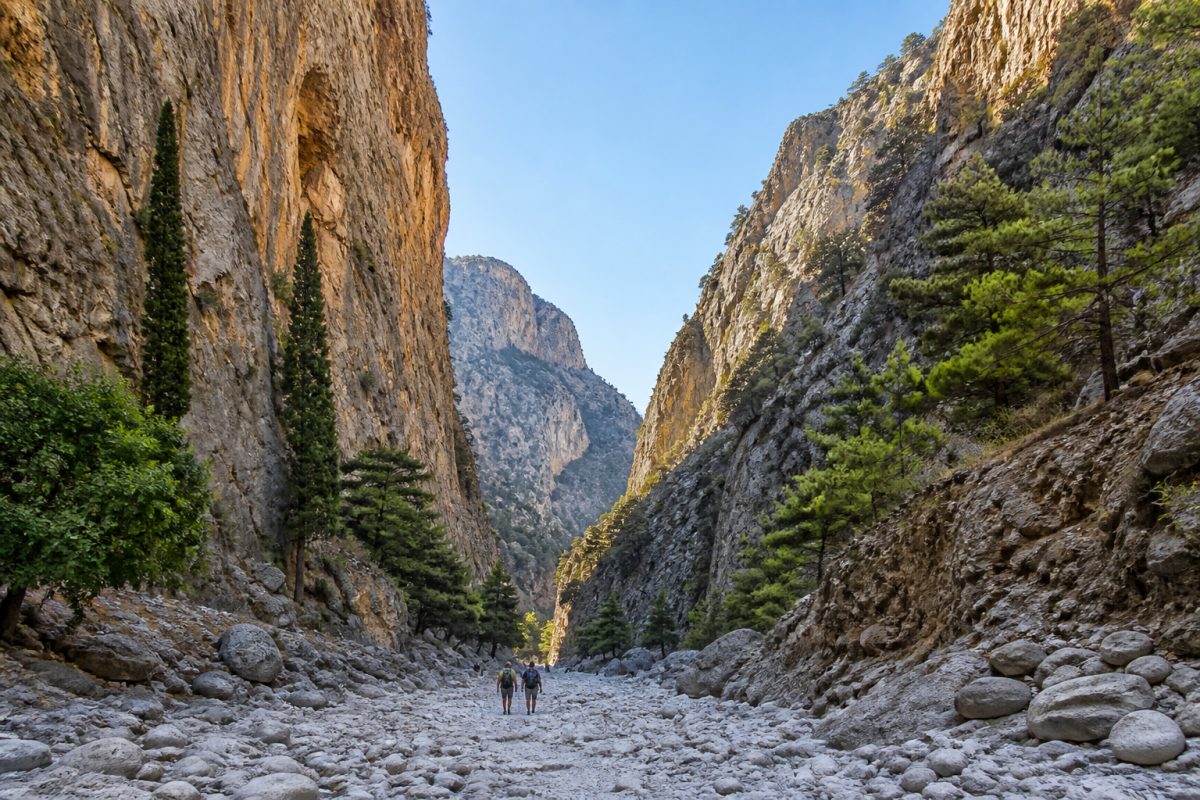
Every summer, thousands of visitors walk the Samaria Gorge — the longest walkable gorge in Europe and the highlight of many a Crete holiday. And every summer, a good number of them reach the end of the trail, sit down on the beach at Agia Roumeli, and realise something nobody told them: there is no road out of here.
The Samaria Gorge is not a loop. It is a one-way, downhill walk that starts high in the White Mountains and finishes on the Libyan Sea, in a village that can only be reached on foot or by boat. Getting to the start is easy. Getting back is the part that needs planning — and it is the part most guides gloss over.
This guide covers the whole day, end to end: how to reach the trailhead, what the walk is actually like, which ferry to take, and how to be back at your hotel in time for dinner.
The scenery earns every bit of its reputation. The trail drops steeply through pine forest, passes the abandoned village of Samaria — whose residents were relocated when the park was created — and then squeezes through the Iron Gates (Sideróportes), where the walls close to barely three metres apart while rising some 300 m overhead. If you are lucky you will spot a kri-kri, the wild Cretan goat that lives almost nowhere else on earth.
Here is the shape of the day, and why it trips people up:
So a single day involves three separate legs, and you finish the day roughly 80 km away from where you started, on the opposite coast. Miss the last ferry and you are spending the night in Agia Roumeli, whether you packed for it or not.
The entrance is at Xyloskalo, at the edge of the Omalos plateau, reached by a winding mountain road that climbs sharply from the north coast. Approximate journeys:
An early start is not optional. The gate closes to full crossings at 16:00, the hike takes most people six hours, and you need to comfortably make an afternoon ferry. Most walkers set off between 07:00 and 08:30. From Chania that means leaving around 06:00; from Heraklion, closer to 04:30.
This deserves its own warning, because it is the single most common mistake. If you drive yourself to Omalos, your car will still be at Omalos when you finish. You will be in Agia Roumeli, a ferry ride and a long bus journey away, with no realistic way to retrieve it that evening.
People do solve this — usually by taking a bus or taxi back up to Omalos the following day, which costs a good chunk of a holiday morning. If you have a hire car, the cleaner solution is to leave it at your hotel for this one day and arrange transport instead.
The first three kilometres are the hardest, and not for the reason most people expect. The trail drops sharply down the Xyloskalo — the "wooden staircase" — losing several hundred metres of altitude in a short distance. It is relentlessly downhill, and it is your knees, not your lungs, that will complain. Walking poles are genuinely worth carrying.
After that the gorge opens out and the walking becomes easier, following a stony riverbed past springs and rest stations. Note that the ground is loose rock for much of the way, so proper footwear matters more than fitness.
A few practical points for the current season:
You emerge from the gorge, walk the last stretch into the village, and — if you have timed it well — have an hour or two to swim in the Libyan Sea and eat something before your boat. It is a genuinely lovely way to end the walk.
Ferries are operated by Anendyk, and there are two directions to choose from:
In peak season there are usually several afternoon departures, with the 17:30 boat being the main one that gorge walkers take. Buy tickets at the kiosk in Agia Roumeli when you arrive — there is no online booking for foot passengers, and reservations are only needed if you are bringing a vehicle.
Do not treat the timetable as fixed. Sailings vary by month and by day of the week, and rough seas can cancel them. Check the current schedule before your trip and give yourself a buffer.
The ferry drops you at a small south-coast port in the early evening, still a long way from the north coast where most hotels are. Typical return journeys:
KTEL buses are timed to meet the main ferries and run to Chania, but after seven hours of walking, a bus that stops in every village is a long final hour — and if the ferry is delayed, connections get tight. A private transfer from Chora Sfakion or from Sougia means a driver is waiting at the port when the boat comes in, takes your bag, and drives you straight to your door.
Here is how a well-planned Samaria day looks from a hotel near Chania:
It is a long day — around fourteen hours door to door. That is worth knowing in advance, especially if you are travelling with teenagers or older relatives.
If 16 km downhill sounds like too much, there is an excellent alternative. Take a ferry to Agia Roumeli, walk up into the gorge as far as the Iron Gates — roughly 3 to 4 km each way — and then return the same way to catch your boat back.
You see the most spectacular section of the gorge, you skip the brutal descent, and you keep full control of your schedule. It is a genuinely good option for families with younger children, and one that far too few visitors know about.
The gorge is busiest from June to September, and that is exactly when local taxis at Omalos and the south-coast ports are hardest to find on the day. Booking ahead locks in a fixed price, guarantees a driver at a 05:45 pick-up, and means someone is waiting at the port when your ferry docks.
With Transfer-in-Crete you get fixed pricing confirmed at booking, modern air-conditioned vehicles sized to your group, child seats on request, English-speaking local drivers, and 24/7 availability — including the early starts that a Samaria day demands.
The gorge is the finest day's walking in Greece. Sort out the transport, and all you have to think about is the view.
Compare top Heraklion airport destinations, travel times, and transfer planning tips for a comfortable, fixed-...
Read more
Minivan versus taxis in Crete: compare space, costs, pickup reliability, and comfort to choose the right airpo...
Read more
Book an airport meet and greet in Crete for a clear, comfortable arrival, with a professional driver, flight t...
Read more